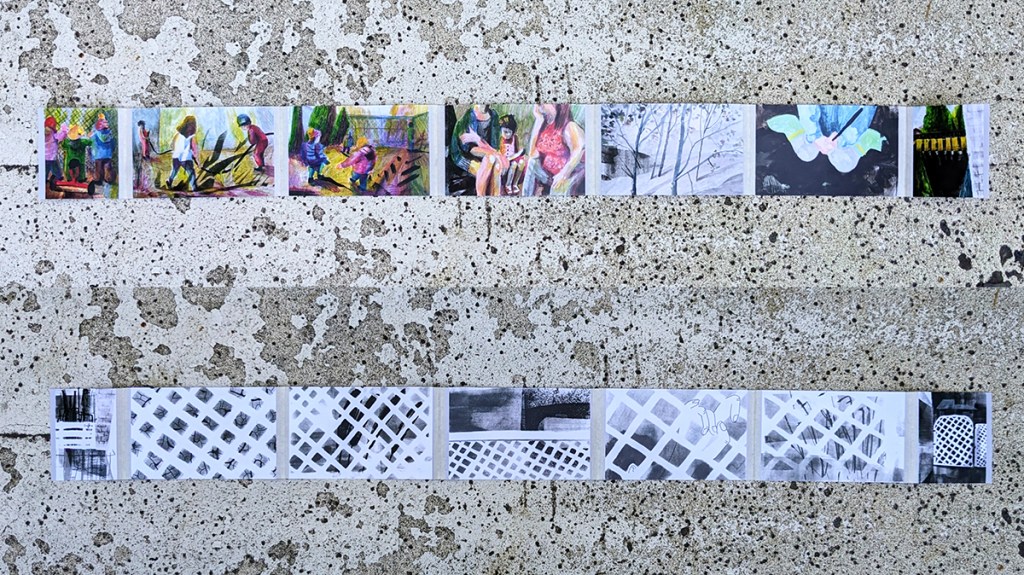
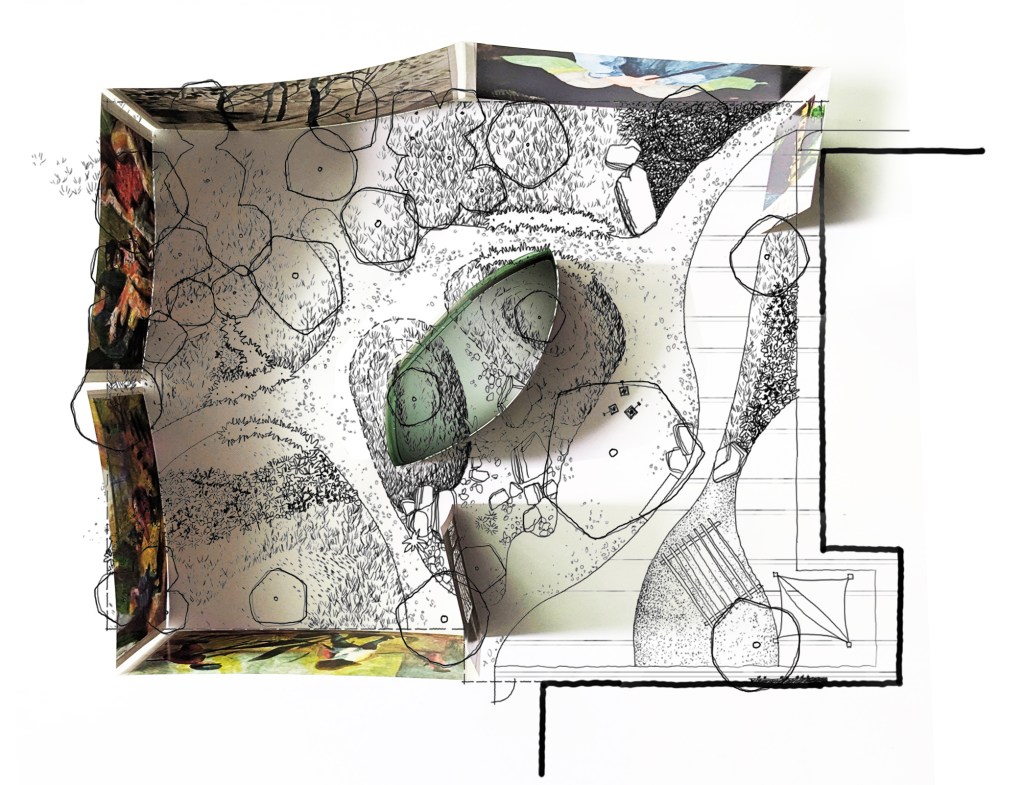
I compose a zine made out of seven panels and a bellyband (a paper circle that wraps around the entire zine, when folded). Each panels represents a particular section of the playground fence and the life unfolding “on the other side”. The two stories are not in opposition to each other, but in a conversation. The two end pieces depict playground gates and speak to the multi-scalled connections of the centre to the larger context – whether that’s the extractivist logics of the petrol-chemical complex which employed many of the centre’s families, or the immediate neighborhood and the borrowed landscape of private backyards and street trees. The drawings mix different perspectives, shifting the views from above to eye-level to intense macro-zoom. The two sides are created with different materials and techniques. The “outside” panel is rendered in black-ink stenciling and black liner, while “inside” panel includes gouach and watercolour pencils drawings. The juxtaposition is offered in direct response to the commonly-held belief that the conventional cookie-cutter playgrounds offer little to children’s worlds (Globe, 2024; Mental Floss, 2015; Guardian, 2019), a position disputed by geographers Horton and Kraft (2018a, 2018 b) who showed deeply complex and divergent socio-political lives of children multiplied by the “the localised differentiation of play” (2018b, p. 225).
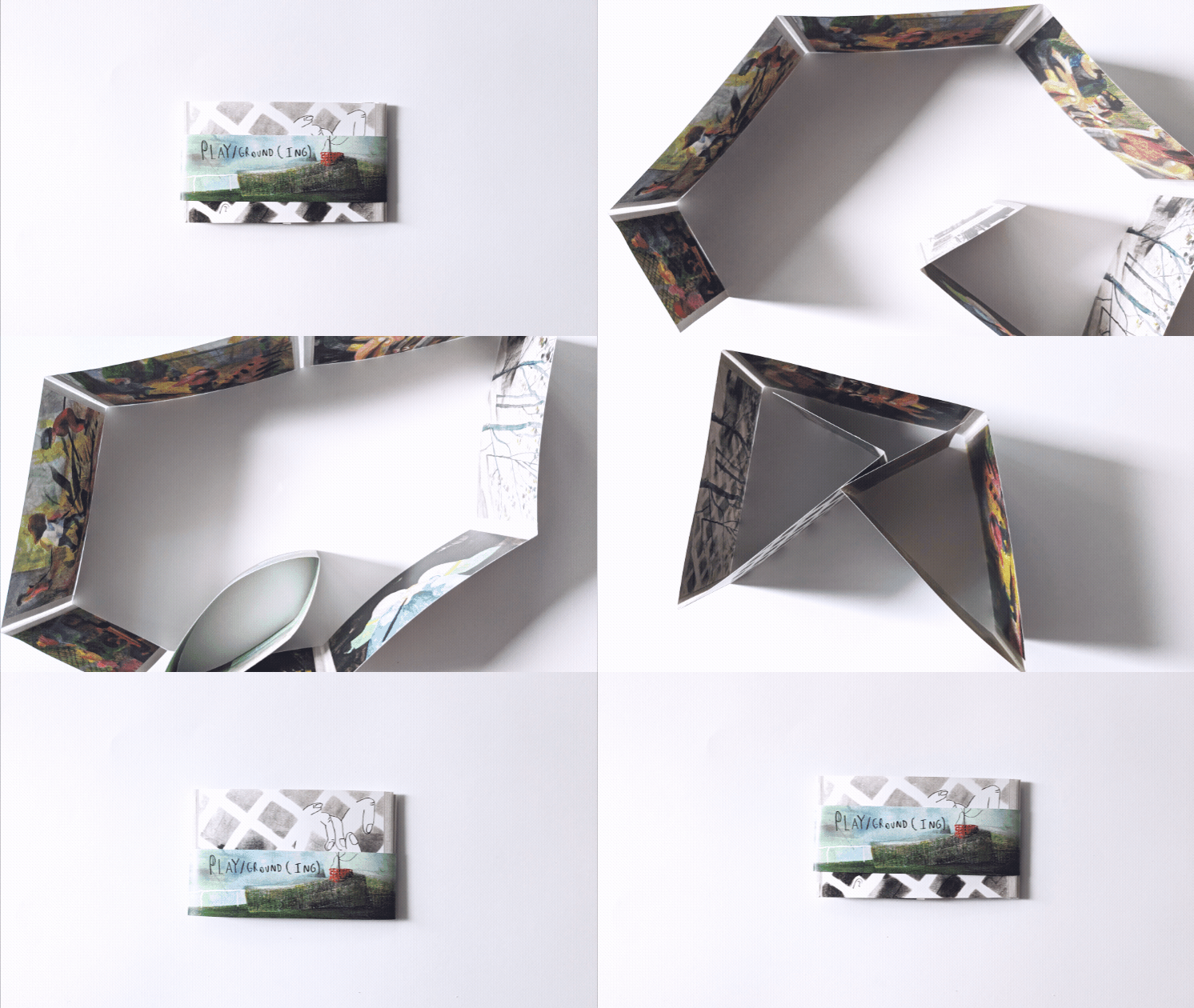
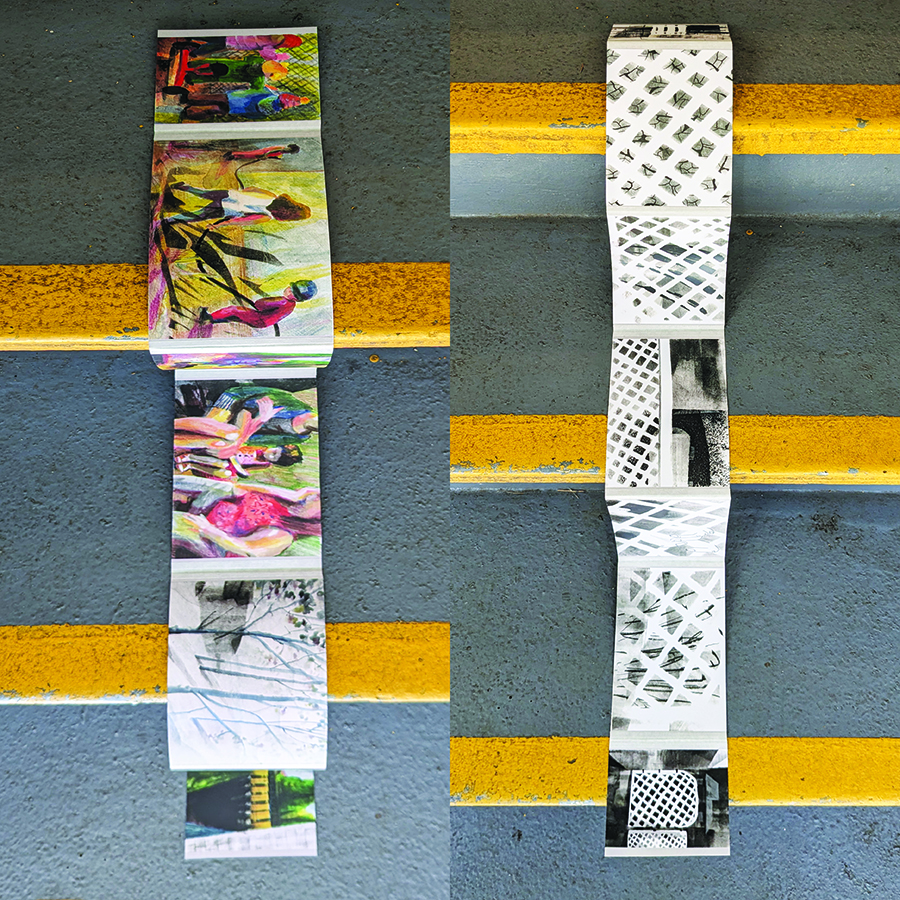
Unfolded, the zine encompasses the sections of the fence that wraps the entire playground. However, what I am concerned here are neither the qualities of the playground fence that may or may not support play or interactions (Pitsikali & Parnell, 2020) nor the fences as the technology of othering of children (Power & Somerville, 2015). Rather, in considering fences as part of “a system of transaction and a system of mobility” (Instone, 1999, p. 377), the zine attends to how the dynamism of folding/unfolding/folding-differently plays with the shifting territoriality of the space. The intention is to emphasize the fence as an active participant in the creation of the ecological milieu of the space, in the creating, interrupting, and re-configuring of the playground networks, and, thinking with Instone’s (1999) proposition of queering fences, a feature implicated in the creation of both divisions and connections.
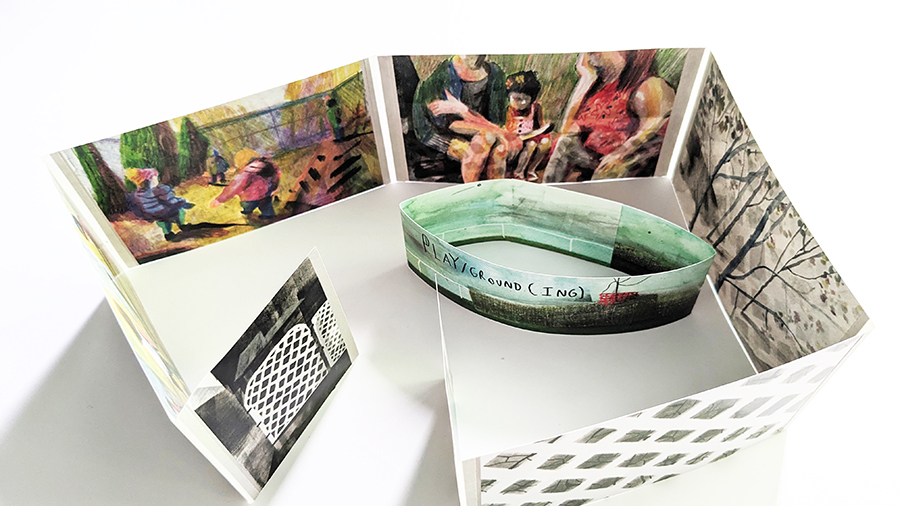
In highlighting its physicality, the fence is taken up in the literal sense as the background against and through which multiple connections and transgressions take place.

⊂(◉‿◉)つ
In performing the zine-making, zine-folding, zine-fingering through the the more-than-representational, the fence is thought as more than a backdrop or a tool of delineating the familiar boundaries. Its geometrical re/configurations, along with a movable bellyband which features a drawing of the playground berm, speak to how the normative, familiar and habitual (playground fences) can be attended to through its generative rhythms.
 TZG Portfolio